


The family balance sheet: seeing wealth beyond the money
Victoria Rose · Confiance Private Office
Most families know what they are worth. Fewer know whether they are ready to hand it on.
A fortune can be counted at any moment. Whether it will last cannot. That depends on things no statement records: the readiness of those who come next, the knowledge the family has gathered and handed on, and a common understanding of what the wealth is meant to serve. A family that tends only its assets is looking after the smallest part of what it owns.
In this article I set out a simple tool for seeing the rest of the picture: a family balance sheet, scored across five capitals and turned into a plan for the next 12 months.
What the research does and does not show
You will often read that 70 per cent of wealthy families lose their wealth by the second generation. The figure is worth handling with care.
It is usually traced to Preparing Heirs, a book by Roy Williams and Vic Preisser, who work in the field of inheritance. The book’s description gives a major reason for those losses: heirs who were not prepared to take on responsibility for the family’s wealth.2 It is a practitioners’ figure, published in a book rather than a peer-reviewed journal, and “failure” there means losing control of the assets. It is useful as a warning. It is not a measured rate.
A second statistic says that about 30 per cent of family businesses survive into the second generation and 13 per cent into the third. It is usually credited to John Ward’s 1987 study of 200 Illinois manufacturing companies tracked from 1924 to 1984. A 2016 review in Family Business Magazine shows that this is not what Ward found.3 He measured whether each firm survived as an independent company under the same name. Twenty per cent did, and of those, 13 per cent were still owned by the same family. On that measure, a family company that merged with another counts as one that did not survive, whatever the outcome for the family.
So neither number is a law of nature. The more useful part of the Williams and Preisser work is not the percentage but the reason it gives: people who were not ready.
Australian evidence points the same way from a different angle. The Productivity Commission found that among older Australians whose last surviving parent died in the previous two decades, about one third of the link between their wealth position and their parents’ was due to inheritances.4 Discussing how that link grows stronger as children age, the Commission says it likely reflects wealthier parents investing more in their children’s education and broader human capital. Inheritance is only part of the story.
The stakes are rising. The Commission projects the total value of inheritances in Australia to increase nearly fourfold between 2020 and 2050.4
The family balance sheet
The idea is not new. James E. Hughes Jr’s book Family Wealth: Keeping It in the Family is about how families preserve their human, intellectual and financial assets, and it includes a chapter on the family balance sheet.1 I use an adaptation of the idea with the families we work with: five capitals, held together by governance.
- Human: the health, capability and independence of each family member.
- Intellectual: what the family knows (how its assets work, where the documents are, what earlier generations learned) and how well that passes between generations.
- Social: trust inside the family, and its standing outside it with advisers, partners and the community.
- Purpose: agreement on what the wealth is for, and the values that guide its use.
- Financial: the assets across every entity, and the debts, tax and costs set against them.
Governance is not a sixth capital. It is the frame around the five: who decides what, how, and when the family reviews it.
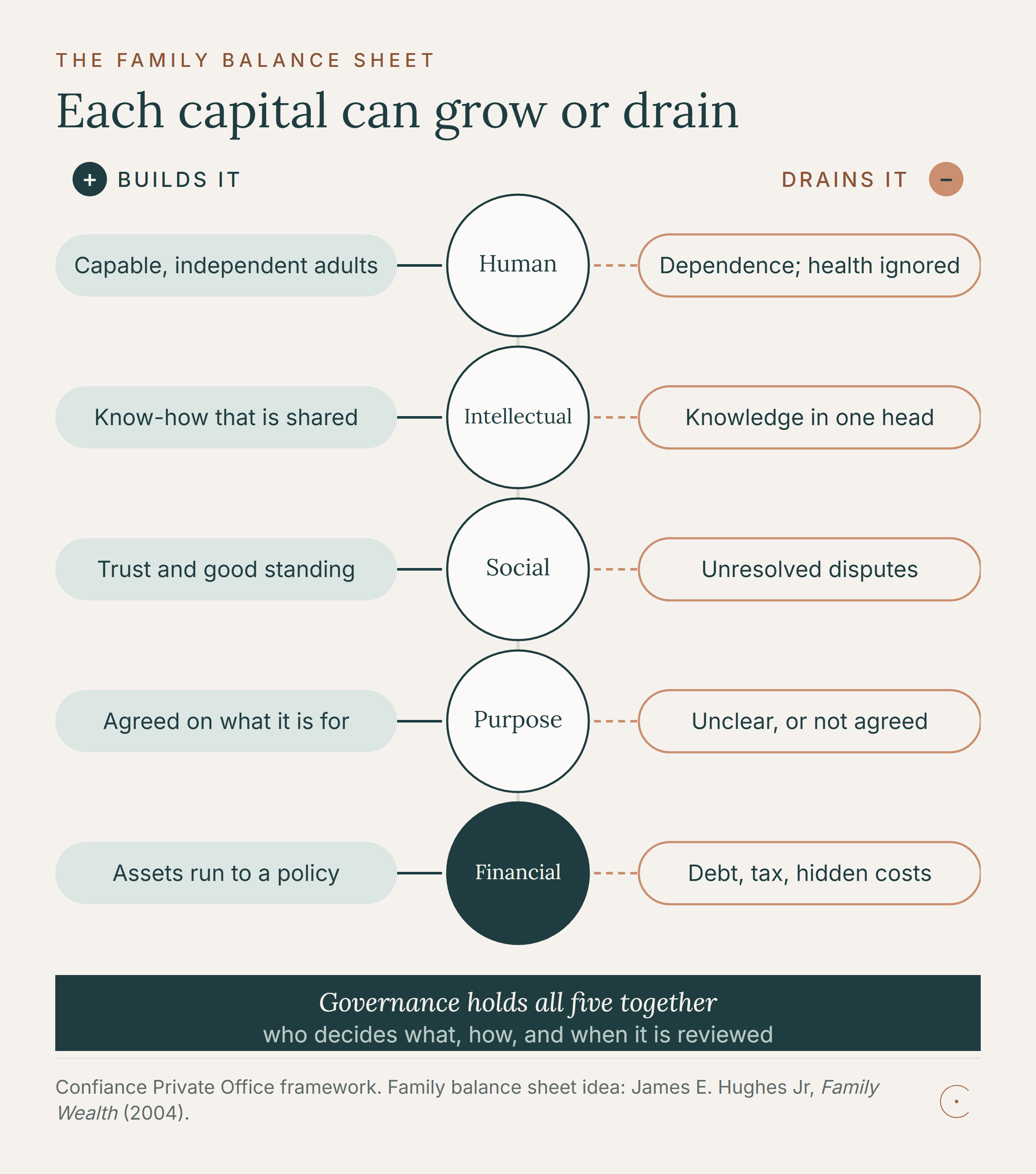
As on any balance sheet, each line has two sides. A capable, independent adult is an asset to human capital; dependence on distributions is a liability. Knowledge shared by three people is an asset. A structure that only the founder understands is a liability that appears on no statement.
How to score your family balance sheet
Scoring sounds clinical. In practice it is a structured way to have conversations families otherwise put off.
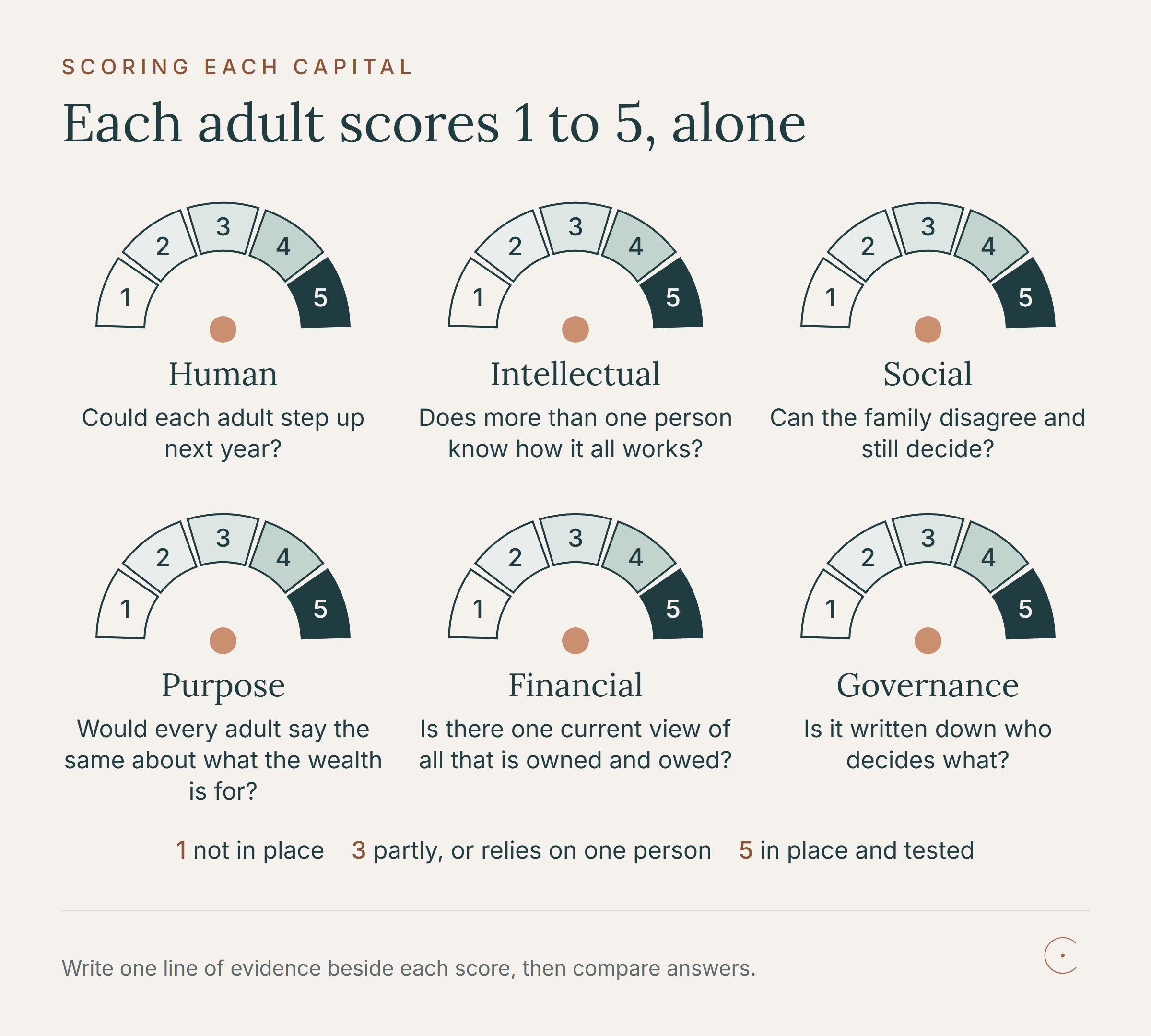
- Each adult scores alone. Rate each capital from 1 to 5 against one plain question (Figure 2), privately and before any discussion.
- Write one line of evidence beside every score. “Our wills were updated last year” is evidence. “We’re fine” is not.
- Look at the spread, not only the average. When two people score the same capital 2 and 5, the disagreement is the finding.
- Score governance last. It is often the lowest, and it tends to explain the rest.
- Repeat once a year with the same questions, so the family can see movement.
An independent facilitator can keep the conversation even-handed, but the scores and the conclusions belong to the family.
Reading the gaps: three common patterns
Figure 3 shows a composite, fictional family: two parents and three adult children. It is an illustration, not a case study.
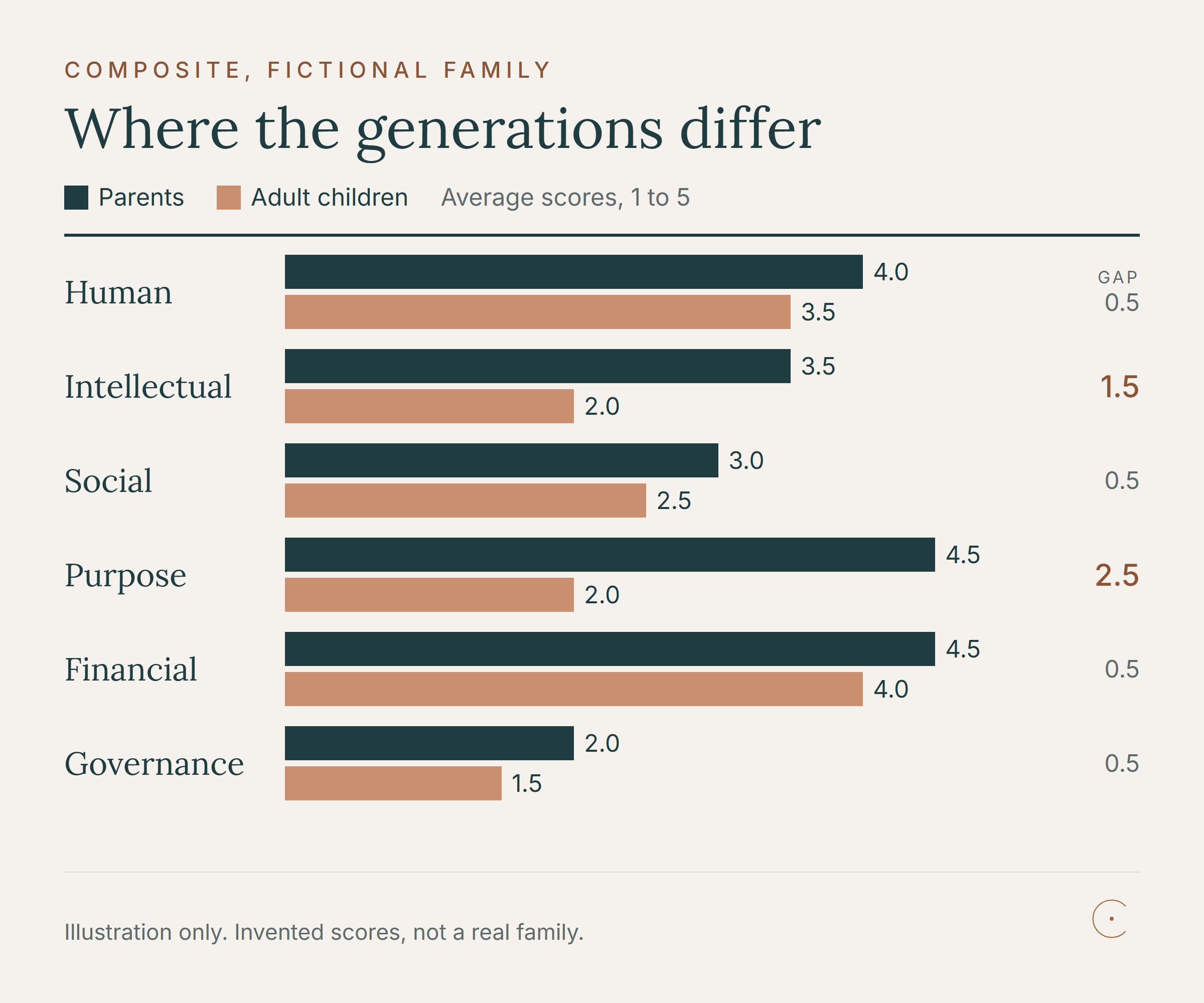
Three patterns are worth looking for in any result.
- Strong portfolio, thin bench. Financial capital scores well, while human and intellectual capital score lower in the next generation. The money is well run, by people who will not always be there.
- One generation’s purpose. The parents know exactly why the wealth exists; the children cannot say. In the example, purpose shows the widest gap: 4.5 against 2.0.
- Everything in one head. Intellectual capital and governance score low, especially for the next generation. One person holds the history, the adviser relationships and the knowledge of where everything is. That works until the day it does not.
A family with the scores in Figure 3 might be tempted to spend next year reviewing its investment strategy. The scores say the work is elsewhere.
Turning scores into a 12-month plan
Choose the two lowest scores or widest gaps. For each, set one action per quarter, one owner and one date. For the fictional family above, that might look like this:
- Quarter 1, purpose: a half-day family meeting, chaired by someone other than a parent, to draft one paragraph on what the wealth is for.
- Quarter 2, intellectual: a family records register listing every entity, adviser and key document and where it is kept, with two family members who know how to use it.
- Quarter 3, purpose and human: each adult child sits in on one investment or board meeting as an observer, with a debrief afterwards.
- Quarter 4, governance: a one-page note of who decides what, agreed at an annual family meeting. Then score again.
None of this needs a new structure or a new product. It needs time, a chair and someone to follow up.
Where to start
If you do one thing, ask each adult in your family the same question, privately: what is this wealth for? Then compare the answers. The gap between them is the first line of your family balance sheet.
At Confiance Private Office, the family balance sheet is where our work with a family begins. The family makes every decision; our role is to help them see the whole picture and follow through.
General information only. This article is not financial, legal or tax advice and does not take your circumstances into account. Examples are composite and fictional. The five-capitals framework is Confiance Private Office’s own; the family balance sheet concept is credited to James E. Hughes Jr.
Sources
- James E. Hughes Jr, Family Wealth: Keeping It in the Family, 2nd revised and expanded edition, Wiley, 2004. Chapter 4, “The Family Balance Sheet and Family Income Statement”. wiley-vch.de
- Roy Williams and Vic Preisser, Preparing Heirs: Five Steps to a Successful Transition of Family Wealth and Values, Robert D. Reed Publishers (listed as 2004). Book description: Stanford Graduate School of Business alumni books
- “A critical look at ‘survival’ statistics”, Family Business Magazine, 2016, reviewing John L. Ward, Keeping the Family Business Healthy (1987). familybusinessmagazine.com
- Productivity Commission, Wealth Transfers and Their Economic Effects, Research Paper, Canberra, December 2021. pc.gov.au (full report: PDF)